
Summery
A dental deep cleaning, also known as scaling and root planing, is a specialized treatment designed to halt the progression of advanced gum disease. Unlike a routine surface cleaning, it cleans deep beneath the gum line to remove hardened plaque and smooth the tooth roots. At Kingston Smiles NY, Dr. Ibrahim Sayeed uses precise, gentle techniques to eliminate infection, heal bleeding gums, and protect your teeth from bone loss.
If you haven’t been to the dentist in a while, or if you’ve noticed your gums bleeding when you floss, you might hear a phrase during your next checkup that causes a bit of anxiety: “You need a deep cleaning.” It’s completely natural to feel a little protective or skeptical. Many patients wonder, “Is a deep cleaning actually necessary, or is it just an upsell?”
I’m Dr. Ibrahim Sayeed, DDS, and at Kingston Smiles NY, my philosophy is rooted in honest, transparent care. I want to completely demystify this procedure. A deep cleaning isn’t a regular cleaning with extra pressure; it is a vital medical treatment for your gums. Let’s look at exactly what a deep cleaning at the dentist is, how it protects your health, and how to know if you truly need one.
The Difference: Routine Cleaning vs. Deep Cleaning
To understand why a deep cleaning is recommended, it helps to understand what is happening beneath your gums.
| Feature | Routine Cleaning (Prophylaxis) | Deep Cleaning (Scaling & Root Planing) |
|---|---|---|
| Primary Goal | Local numbing is applied for optimal patient comfort | Therapeutic infection control and healing |
| Target Area | Visible tooth surfaces above the gum line | Deep pockets beneath the gum line along the roots |
| Indication | Healthy gums or mild surface plaque | Active periodontal disease (5+ mm pocket depths) |
| Anesthesia | Not required | Local numbing applied for optimal patient comfort |
| Bony Support | Intact and healthy | Protected from further recession and erosion |
What Happens During Scaling and Root Planing?
We break a deep cleaning down into two precise steps to ensure your comfort and long-term healing:
- Scaling: Using specialized ultrasonic and hand instruments, we carefully remove hardened plaque and bacterial toxins from the tooth surface and from deep pockets below your gum line.
- Root Planing: We gently smooth out the rough spots on the roots of your teeth. Why? Because bacteria love to cling to rough surfaces. Smoothing the roots gives your gum tissue a clean, slick surface to firmly reattach to, effectively closing the pockets and blocking out future bacteria.
Because we are working beneath the gum line, we typically use a local anesthetic to ensure you don’t feel a thing. Your comfort is always our first priority.
Do You Really Need One? How to Know
We determine if you need advanced care by painlessly measuring your gum pockets with a specialized instrument during your comprehensive evaluation:
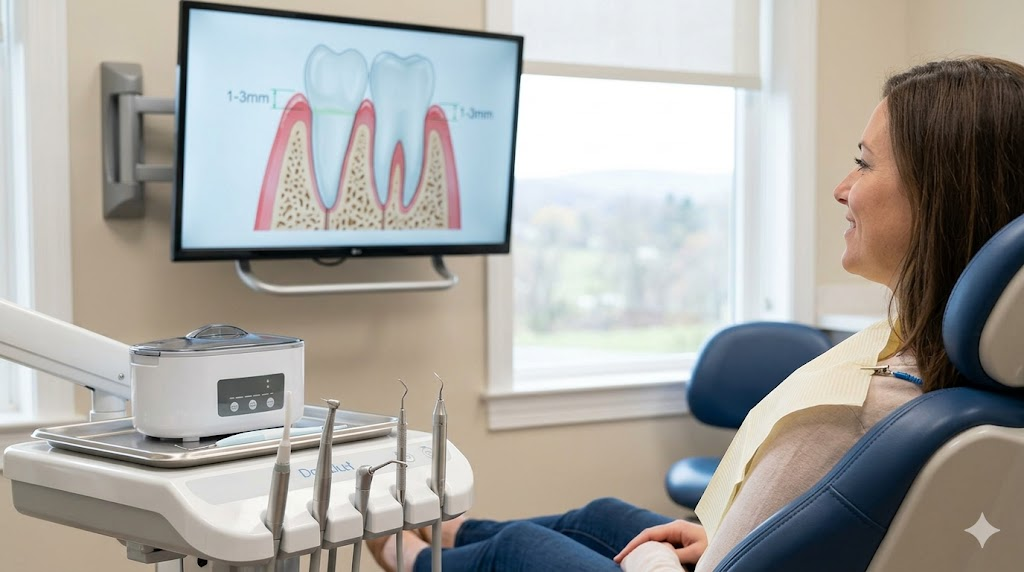
- 1 to 3 Millimeters: Your gums are perfectly healthy, tight, and attached. A routine cleaning is all you need.
- 4 Millimeters: An early warning sign of localized gingivitis (surface-level inflammation).
- 5+ Millimeters: Indicates active periodontal disease. At this stage, a deep cleaning is medically necessary to stop the infection from destroying the structural bone holding your teeth in place.
Common Signs You Need Advanced Gum Disease Treatment:
- Gums that bleed consistently when brushing or flossing
- Persistent bad breath (halitosis) that doesn’t go away with mouthwash
- Red, swollen, or tender gum tissue
- Receding gums that make your teeth look longer than usual
The True Cost of Delaying Treatment
Understandably, patients often ask about the cost of deep cleaning. While a deep cleaning does cost more than a standard preventative visit because it requires localized numbing, specialized instruments, and more of the dentist’s time, it is highly cost-effective compared to the alternative.
If active gum disease is left untreated, the bone supporting your teeth slowly erodes. This leads to loose teeth, shifting bites, and eventually, tooth loss. Treating advanced bone loss later requires complex bone grafts or surgical extractions, which cost significantly more than early intervention. Investing in your gums today saves your smile and your wallet tomorrow.
Compassionate, Non-Judgmental Care in Kingston, NY
Many of our patients in Kingston, Saugerties, and Rhinebeck who require a deep cleaning have simply avoided the dentist for a few years due to life getting in the way or past dental anxiety. Please know that Kingston Smiles NY is a completely judgment-free zone. Our goal isn’t to lecture you on the past; it’s to get your mouth healthy, fresh, and free of infection today.
Healthy gums are the foundation of a beautiful, lifelong smile. If your gums are bleeding or it’s simply been a while since your last checkup, let us help you get a fresh start. Dr. Sayeed and the professional team are here to support you with expert, gentle care.
Protect your smile with transparent, judgment-free care. Our practice works directly with local plans such as CSEA and the Kingston Trust Fund, as well as flexible options like CareCredit and Cherry. Book your consultation online today to get started.
Contact Our Practice
Hours: Tuesday 8 AM–5 PM & Wednesday 8 AM–5 PM
Address: 1105 Locust Street, Kingston, New York, 12401 (Find us on Google Maps)
Phone: +1 845-336-5855
Email: kingstonsmilesny@gmail.com
FAQ: Frequently Asked Questions
Does a deep cleaning hurt?
With modern dental techniques and local anesthetics, the procedure itself should not be painful. You may feel some mild pressure. Afterward, your gums might feel slightly tender or sensitive to cold temperatures for a few days, which is entirely normal as the tissue heals.
How many visits does a deep cleaning take?
To ensure your comfort and avoid keeping your mouth open for too long, we typically divide the mouth into halves or quadrants, completing the deep cleaning over two manageable appointments.
Will my gums grow back after a deep cleaning?
While a deep cleaning cannot reverse severe bone loss, it halts the recession process. It allows swollen, detached gums to heal, tighten, and firmly reattach to the clean tooth roots, protecting them from further recession.
Does insurance cover the deep cleaning cost?
Yes. Because scaling and root planing is a medically necessary treatment for an active infection, most major dental insurance plans (including CareCredit, Cherry Payment, Kingston Trust Fund, and CSEA) cover a substantial portion of the cost. Our team will verify your benefits before your appointment.