TL;DR:
Cracked Tooth Syndrome (CTS) involves microscopic fractures that are often invisible to the naked eye but cause sharp pain when chewing or eating cold foods. Unlike a cavity, the pain is usually intermittent. At Kingston Smiles NY, Dr. Ibrahim Sayeed uses advanced 3D CBCT imaging to locate these hidden cracks before they lead to tooth loss. Early treatment with bonding or a crown can save your tooth from needing a root canal or extraction.
Have you ever bitten down on something and felt a sharp, lightning-bolt flash of pain, only for it to disappear a second later? You look in the mirror, but the tooth looks perfectly white and healthy. You might think, “Maybe it’s just a sensitive tooth,” or “I’ll wait and see if it goes away.”
I’m Dr. Ibrahim Sayeed, DDS, and in my years practicing here in Kingston, I’ve found that these “mystery pains” are often caused by Cracked Tooth Syndrome (CTS). Because these cracks are often microscopic and hidden beneath the gum line or within the tooth, they are among the most frequently misdiagnosed dental issues.
If you are experiencing vague discomfort, don’t wait for it to become a dental emergency. At Kingston Smiles NY, we specialize in finding what other exams miss.
What are Cracked Tooth Symptoms?
The reason Cracked Tooth Syndrome is so frustrating is that the pain isn’t constant. Unlike a traditional “toothache,” the symptoms of a crack are very specific:
- Pain on Release: You feel the “zing” not when you bite down, but the moment you let go of the bite.
- Sensitivity to Temperature: Sharp pain specifically with cold drinks or ice cream.
- Intermittent Discomfort: The tooth might feel fine for three days, then hurt suddenly on the fourth.
- Localized Swelling: If the crack reaches the gum line, you may notice a small, tender “bump” on the gums near that tooth.
Cracked Tooth vs. Cavity: How to Tell the Difference
It is easy to confuse a crack with a cavity, but the treatment and risks are very different.
| Feature | Cracked Tooth Syndrome | Dental Cavity (Decay) |
|---|---|---|
| Type of Pain | The tooth can suddenly split in half. | Dull, lingering, or throbbing ache. |
| Triggers | Chewing and cold temperatures. | Sweets, sugar, and heat. |
| Visibility | Often invisible on standard X-rays. | Usually visible as a dark spot on X-rays. |
| Risk | The tooth can split in half suddenly. | The decay spreads slowly toward the nerve. |
Common Causes of a Broken Tooth in Kingston, NY
Why do healthy teeth crack? Most of the patients I see in Kingston, Saugerties, and Rhinebeck fall into one of these categories:
- Bruxism (Grinding): Years of clenching or grinding (often due to stress) fatigue the tooth structure.
- Large, Old Fillings: Old silver (amalgam) fillings don’t bond to the tooth; they act like a wedge that can eventually split the tooth.
- Bite Misalignment: If your teeth don’t meet evenly, one tooth may be taking thousands of pounds of extra pressure every day.
- Chewing Hard Objects: Ice, popcorn kernels, or even using your teeth as tools to open packaging.
How We Find the “Invisible” Crack
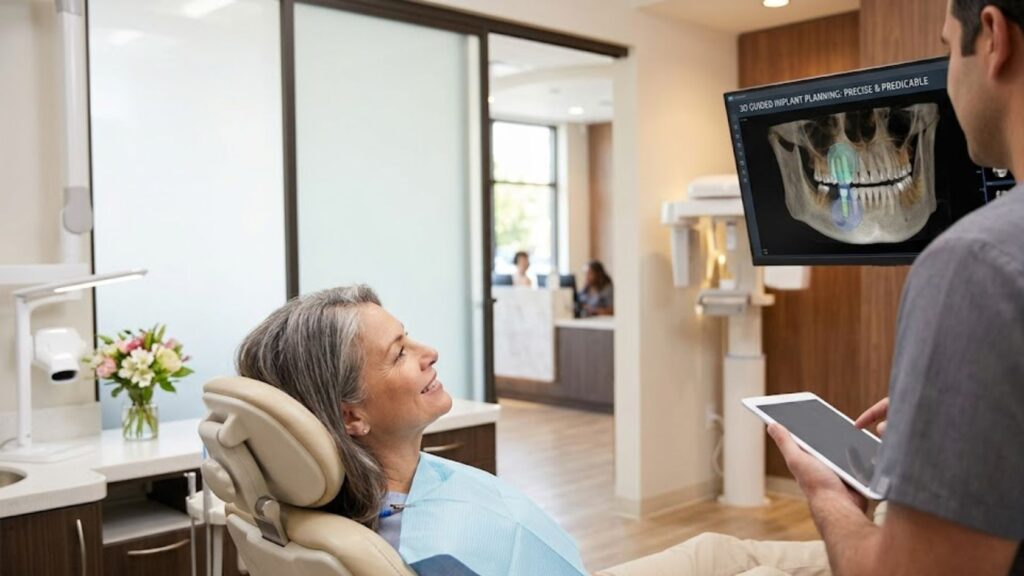
This is where technology makes the difference. At Kingston Smiles NY, we use on-site 3D CBCT scanning.
Traditional 2D X-rays are flat; they can’t show a crack that runs from front to back. Our 3D imaging allows me to rotate your tooth on a digital screen to look for microscopic fractures that indicate Cracked Tooth Syndrome. Finding the crack early is the difference between needing a simple Dental Crown and needing an Emergency Tooth Extraction.
How Dr. Sayeed Treats Cracked Teeth
My approach is always conservative. I want to save as much of your natural tooth as possible.
- Bonding: For very minor, surface-level cracks, we can use a high-strength composite resin to seal the fracture.
- Dental Crowns: The “gold standard” for CTS. A crown acts like a permanent brace, holding the tooth together so the crack cannot spread.
- Root Canal: If the crack has reached the inner pulp (the nerve), a Root Canal is necessary to remove the infection before we crown the tooth.
Schedule Your Assessment at Kingston Smiles NY
If you are tired of wondering why your tooth hurts when you eat, let’s get you an honest answer. Experience the precision of 3D diagnostics and the comfort of a practice that puts your needs first.
Call 845-336-5855 or Book Your Consultation Online today. Dr. Sayeed and the team at Kingston Smiles NY are ready to protect your smile.
FAQ: Cracked Tooth Concerns
Can a cracked tooth heal on its own?
No. Unlike a broken bone, a tooth cannot heal itself. Once a crack starts, the pressure of chewing will eventually cause it to grow deeper until the tooth splits or becomes infected.
Does insurance cover treatment for a cracked tooth?
Most plans (Aetna, Fidelis, Anthem BCBS, etc.) cover restorative treatments like crowns and fillings because they are medically necessary to prevent tooth loss.
What if I wait too long?
If a crack travels below the gum line or into the root, the tooth usually cannot be saved and must be extracted. Early intervention is always the most affordable and least painful option.